


The Dimensional Rift
Everything starts, and ends within the rift
Amber Lawson
Firefly
Human Realm
Main Character
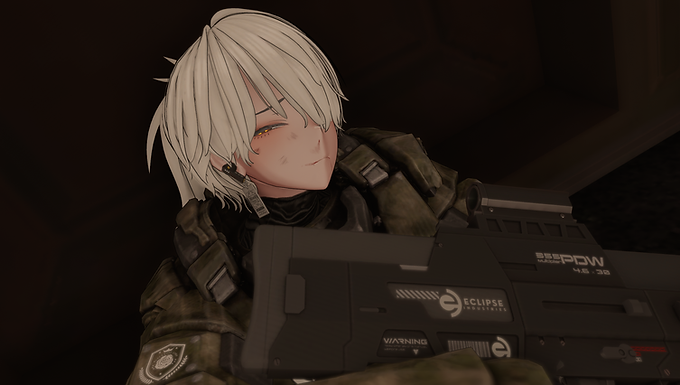
Name: Amber Lawson.
Alias: Firefly, Amby, Sergeant Lawson, Snow White (derogatory).
Age: 27.
Sex: Female.
Race: Human.
Homeworld: Exadea.
Occupation: Advance Spec Ops Unit – Ghost Division Sergeant.
Appearance
Height: 6’0” (185 cm).
Weight: 196 Ibs (88.9 kg).
Build: Lean and Muscular.
Eye Colour: Amber Gold.
Hair Colour: White.
Family
Mother: Grace Porter (former Medi Pilot within the Emergency Rapid Response Unit)
Father: Bradley Lawson (former mechanical & robotical engineer at Cerberus Dynamics) (Owner of the Lawson Repair Shop)
Younger Sisters: Faith Lawson (Student at Starlight Academy), Megan Lawson (Student at Starlight Academy)
Additional Info
Affiliations: BlackRose Military Sector, Ghost Division, Starlight Academy (former).
Personality
Amber is the kind of soldier who walks into a room already looking like she has found five problems with it and is deciding which one to insult first. Headstrong to a fault, hot-headed under pressure, and almost aggressively blunt, she has never been the type to soften her words for the comfort of others. In the BlackRose Military Sector’s Advance Spec Ops Unit, Amber is respected for her skill, nerve, and ability to make split-second decisions in the worst possible conditions, but her attitude makes her a constant headache for superior officers. She questions bad orders, calls out weak planning, and has a habit of answering authority with dry sarcasm when patience would be the safer option. Her mouth often gets her into trouble long before her actions do, and while her squadmates know her sharp tongue usually hides a sharper mind, many commanders see her as insubordinate, reckless, and difficult to control.
Beneath the temper and bite, Amber is fiercely loyal, especially when it comes to her family. Around her mother, father, and younger sisters, the hard edges she carries in uniform begin to loosen, revealing a more caring, gentle, and protective side that she rarely allows anyone else to see. Faith and Megan are the quickest way to disarm her; with them, her sarcasm becomes playful instead of cutting, her bluntness turns into honest guidance, and her quick wit is used to make them laugh, calm them down, or push them to believe in themselves. She may tease them mercilessly, call out their nonsense without hesitation, and act like she is too busy to fuss over them, but Amber is deeply invested in their happiness and safety. To her family, she is not just Firefly or Sergeant Lawson; she is the older sister who remembers the little things, gives rough but sincere advice, and would burn through anything standing between her sisters and a better future.
Background/info
Where the Fire First Glowed
Amber Lawson’s story begins in Clearfield, a sprawling metropolis carved into the frozen expanse of the Cryostock Peninsula on Exadea, a city where towering industrial frameworks pierced the pale sky, and neon-lit streets cut through constant snowfall like veins of stubborn life. Clearfield was a place that demanded resilience. The cold was unforgiving, the pace relentless, and the expectations suffocating, but it was also alive with ingenuity, trade, and a quiet, unyielding sense of community among those who called it home.
Amber grew up in a modest district tucked between manufacturing blocks and transit lines, where the hum of machinery and distant engine roar became a constant backdrop to her childhood. Their home was never extravagant, but it was warm, filled with the scent of machine oil from her father’s work clothes and the comforting chaos of a family that refused to fracture under pressure.
Her father, Bradley Lawson, owned a small but well-regarded repair shop, Lawson Repair Shop, a cluttered sanctuary of scrap parts, half-dismantled drones, and aging mechanical cores waiting for a second life. For Amber, the shop became more than a workplace; it was a second home. From a young age, she spent hours perched on tool crates or leaning over workbenches, watching her father’s hands move with quiet precision as he brought broken machines back from the brink.
It was in that shop that Amber first developed her defining traits. She learned how to take things apart, not just machines, but ideas, arguments, and problems. She asked too many questions, challenged explanations that didn’t satisfy her, and quickly developed a blunt, no-nonsense way of speaking that often caught adults off guard. If something didn’t make sense, she’d say so, loudly, and without apology.
Where her father taught her patience and craft, her mother, Grace Porter, taught her compassion and steadiness. A former Medi-Pilot with the Emergency Rapid Response Unit, Grace had seen the worst of what the world could do, yet she carried herself with quiet warmth. From her, Amber learned that strength wasn’t just about endurance, it was about who you protected and why.
Even so, Amber’s childhood was not defined solely by hardship or responsibility. Much of it was shaped by her role as the eldest sibling.
When Faith and Megan were born, Amber’s world shifted in ways she never openly talked about. She became their first protector, their reluctant role model, and, at times, their unofficial babysitter. The cramped living space and long hours at the shop meant the three sisters spent much of their time together, turning hallways into imaginary battlefields, rooftops into staging grounds for grand adventures, and broken scrap into makeshift props for whatever story Amber decided to spin that day.
Despite her already sharp tongue, Amber’s behaviour around her sisters softened in subtle but meaningful ways. Her sarcasm became playful, her bluntness gentler, filtered just enough to guide rather than sting. She entertained them with dramatic storytelling, improvised performances, and exaggerated characters, often acting out entire scenes just to make them laugh. It was in these moments that her creativity thrived, revealing a side of her that few outside her family would ever believe existed.
This early love for storytelling and performance would eventually lead her to Starlight Academy.
Unlike many who sought entry into the prestigious institution for technical or military advancement, Amber’s path was different. She enrolled with a focus on acting, creative writing, and the sociology of peace, war, and social conflict, fields that, to outsiders, seemed mismatched and unfocused. In truth, they reflected the complexity of her mind.
Acting gave her an outlet she never had in her everyday life, a way to explore emotions she kept tightly controlled, to step into perspectives beyond her own, and to refine her ability to read people. Creative writing sharpened her already quick wit, allowing her to craft dialogue, tension, and narrative with the same sharpness she used in conversation. Meanwhile, her sociological studies gave structure to her instinctive understanding of conflict, authority, and human behaviour, teaching her not just how people fought, but why.
At Starlight Academy, Amber stood out, not always for the right reasons.
She challenged instructors, questioned established theories, and often tore apart discussions with clinical precision and cutting commentary. Her work was brilliant when she applied herself, her insights uncomfortably accurate, but her attitude earned her a reputation as difficult, confrontational, and unwilling to conform. She excelled in analysis and improvisation, yet struggled with authority, finding it nearly impossible to stay silent when she believed something was flawed.
Still, those who looked past her attitude saw something more dangerous than defiance: clarity. Amber had an uncanny ability to read situations, anticipate reactions, and adapt in real time, skills that would later make her invaluable in far more volatile environments than a classroom.
Despite the intensity of her studies, Amber never fully detached from home. She returned whenever she could, stepping back into the familiar rhythm of the repair shop, trading barbed remarks with her father, and slipping effortlessly into her role as older sister. Those visits grounded her, reminding her of who she was beyond expectations, ranks, or reputation.
By the time Amber left Starlight Academy, she was no longer just the sharp-tongued girl from Clearfield. She was someone who understood people, conflict, and pressure on a deeper level than most, someone who could break down a situation as easily as she could dismantle a machine.
That combination of insight, unpredictability, and raw capability would eventually draw the attention of the BlackRose Military Sector, where her talents would be reforged into something far more dangerous.
But even as she stepped into that world, of orders, operations, and controlled violence, the foundations of who Amber Lawson truly was remained unchanged:
A girl shaped by cold streets and warm family, a mechanic’s daughter with a storyteller’s mind, and an older sister who learned early that strength meant standing between the people you loved and everything else.
The Firefly Enters the Dark
Amber did not apply to the BlackRose Military Sector. BlackRose came to her. It started quietly, almost insultingly so.
During her final term at Starlight Academy, Amber had already built a reputation that split opinion clean down the middle. To some instructors, she was one of the most perceptive students they had ever taught; to others, she was a disruptive force who refused to stay in line. Her work in Sociology of Peace, War, and Social Conflict had gone beyond academic interest, it became pointed, analytical, and, at times, uncomfortably critical of military doctrine itself.
She didn’t just study conflict. She dismantled it. One particular lecture would later be flagged in a BlackRose internal report.
The topic had been urban suppression tactics and asymmetrical response strategies. While most students discussed theory, Amber tore into the structure of command decision-making itself, highlighting delays, ego-driven orders, and the predictability of high-ranking officers in crisis scenarios. She outlined, in exacting detail, how small, highly adaptive units could outmanoeuvre larger, rigid forces not through strength, but through speed, unpredictability, and independent decision-making.
Then, with a dry tone that would become infamous, she reportedly added:
“Your biggest weakness isn’t the enemy. It’s the assumption your orders are smarter than the situation.”
That statement earned her disciplinary notice. It also earned her attention.
Unbeknownst to Amber, certain Starlight Academy lectures, particularly those related to conflict theory, were occasionally monitored or reviewed by BlackRose’s Military Intelligence Division. Her analysis, tone, and outright disregard for authority marked her profile immediately.
Not as a problem. But as a potential asset.
For several weeks, nothing happened. At least, nothing visible.
Amber continued her routine, lectures, assignments, occasional returns to Clearfield. But she began to notice small irregularities: unfamiliar individuals attending classes too attentively, subtle redirection in certain academic discussions, and once, a question from a “visiting assessor” that felt less like curiosity and more like evaluation.
They were testing her. Pushing her to speak. Seeing if she would hold back.
She didn’t.
If anything, she doubled down, dismantling flawed arguments faster, speaking more openly, and making it abundantly clear that she had no interest in pretending authority figures were always right.
By the time she graduated, BlackRose had already built a profile on her: highly perceptive under pressure, exceptionally strong improvisational thinking, psychological awareness beyond standard training baselines, openly insubordinate tendencies, Low tolerance for inefficient leadership.
To most divisions, she was a discipline risk. To one particular unit, she was exactly what they needed.
Amber’s recruitment didn’t begin with an offer. It began with a problem.
Three weeks after her graduation, while back in Clearfield helping at her father’s repair shop, Amber was approached, not by uniformed officers, but by two individuals who didn’t belong in the area. They carried themselves wrong, too still, too aware, too controlled.
They didn’t introduce themselves immediately. Instead, they gave her a scenario. A fabricated one, or at least, that’s what it appeared to be.
A compromised transport route. A fractured chain of command. Limited communication. Civilian risk. Then they asked her a simple question:
“You’re in charge. What do you do?”
Amber didn’t hesitate.
She picked the situation apart, dismissed half their assumptions outright, rewrote the operational priorities, and proposed a response that relied on small-unit autonomy, rapid adaptation, and minimal reliance on central command. At one point, she reportedly paused mid-explanation and said:
“If your officers need constant orders to function, you’ve already lost control.”
Silence followed. Then one of them smiled. That was the moment the recruitment became real.
BlackRose did not need more soldiers. It needed operators.
The Advance Spec Ops Unit’s – Ghost Division operated differently from every other military branch. They were deployed where conventional forces failed, where communication broke down, where plans collapsed, where adaptability mattered more than obedience.
Ghost Division didn’t want perfect discipline. It wanted controlled unpredictability. Amber fit the profile uncomfortably well. But there was one problem: She didn’t want in.
Amber refused the first offer. Flatly.
She had no interest in becoming part of a system she had spent years criticising. She didn’t trust command structures that valued control over understanding, and she certainly didn’t trust BlackRose to use her skills for anything she would agree with.
For a brief moment, that should have ended it. But Ghost Division wasn’t known for taking “no” at face value. Instead of pushing harder, they changed tactics. They showed her reality. Not propaganda. Not speeches. Data.
Unfiltered operational reports. Failed missions. Civilian casualty statistics tied directly to command hesitation and rigid decision-making. Situations where people like her, if present, might have changed the outcome.
They didn’t try to convince her she was wrong. They showed her where she was right. And where it mattered. That was what shifted things.
Not loyalty. Not patriotism. Responsibility.
Amber didn’t join BlackRose for the institution. She joined because she knew she could do it better. That didn’t make her loyal. It made her dangerous. Her final condition before accepting was simple:
“If I’m there, I make the call when it matters. I’m not standing around waiting for someone ten steps removed to tell me what I can already see.”
Shockingly, they didn’t refuse. Ghost Division was built for operators like her. Even if command hated dealing with them.
Amber’s transition into the unit was… volatile.
She passed training faster than expected, not because she followed instructions perfectly, but because she adapted faster than the scenarios could escalate. She questioned methods, rewrote approaches mid-drill, and often achieved better results than the “correct” solution, though rarely in ways instructors appreciated.
Her file quickly acquired a familiar pattern: exceptional performance, repeated insubordination, high mission success potential, difficult command integration.
Some officers wanted her reassigned. Others wanted her removed entirely. Ghost Division overruled them. The reasoning was simple: You don’t discard an asset because it’s hard to control. You learn how to use it.
Within months, Amber had earned a reputation across BlackRose Military ranks: To superior officers, she was a persistent problem—disrespectful, argumentative, and impossible to fully control. To fellow operators, she was someone you wanted beside you when things went wrong—because they always did. To Ghost Division itself, she was exactly what the unit was built for: Someone who didn’t just follow orders.
But knew when not to. Even after recruitment, one thing never changed: Amber didn’t become part of BlackRose. She remained something just slightly outside it, A soldier who fought within the system…
Without ever fully belonging to it.